Party Games for Large Groups: What Actually Works at 6, 8 and 12 Players
Big groups do not fail because of the game. They fail on controllers and on waiting. Here is what breaks at seven people, what scales past ten, and the verified player counts for each option.
Eight people, one living room, and a plan that falls apart in the first ten minutes. The console has two controllers. The board game on the shelf says four players on the box. Somebody suggests charades, half the room groans, and the evening turns into three conversations and a phone-scrolling contest.
This is the part most party game lists skip. They hand you thirty titles and never mention the two walls that actually decide whether a big group has fun: how many people can physically press a button, and how long everyone else sits there waiting. This guide is built around those two walls, with player counts checked against the publishers rather than remembered, and a cheat sheet at the end sorted by how many people are actually coming.
The two walls that break a big game night
Almost every failed party game evening runs into one of two problems, and knowing which one you are facing narrows the choice down fast.
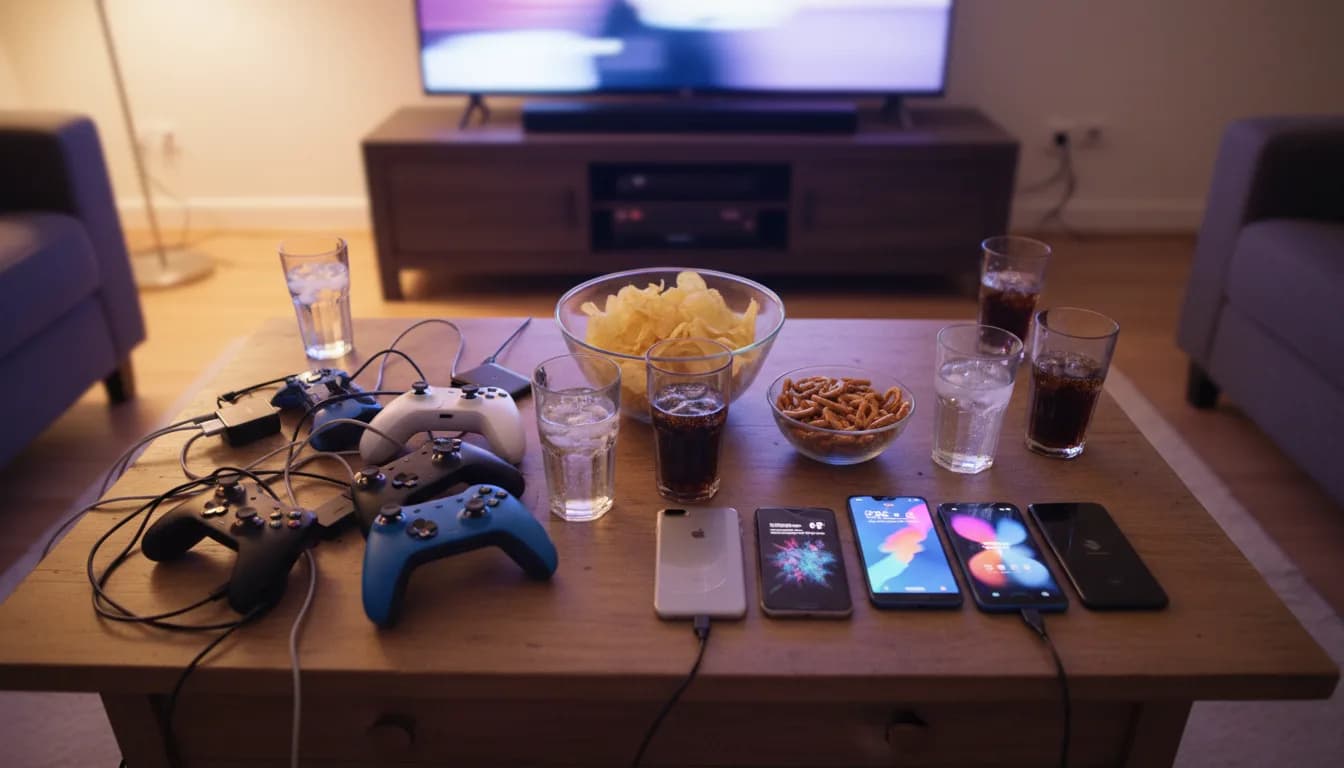
The controller wall. Video games are limited by hardware, not by the game. Four gamepads is the normal ceiling in a living room, and adding more gets expensive and fiddly quickly.
The downtime wall. Board and card games are limited by turns. Every extra player adds waiting time for everyone else, which is why a game that sings at four can drag at eight.
The controller wall: why eight people cannot just play a console game
The maths that decides most game nights: four pads on the table, eight people in the room.
A console ships with one or two controllers and supports four in most games. Getting to eight means buying four more pads, and a spare controller usually costs more than the party game you wanted to play. Then come the practical annoyances: Bluetooth stacks tend to give up somewhere around seven paired devices, so hosts end up mixing wireless pads with USB dongles and a powered hub.
This is not theory. Hosts who run big couch nights describe exactly that rig: a handheld PC in a dock, a USB hub, a couple of Bluetooth pads and a couple more on 2.4 GHz dongles, with the whole thing tested before guests arrive. It works, and it is also the reason most people never get past four players.
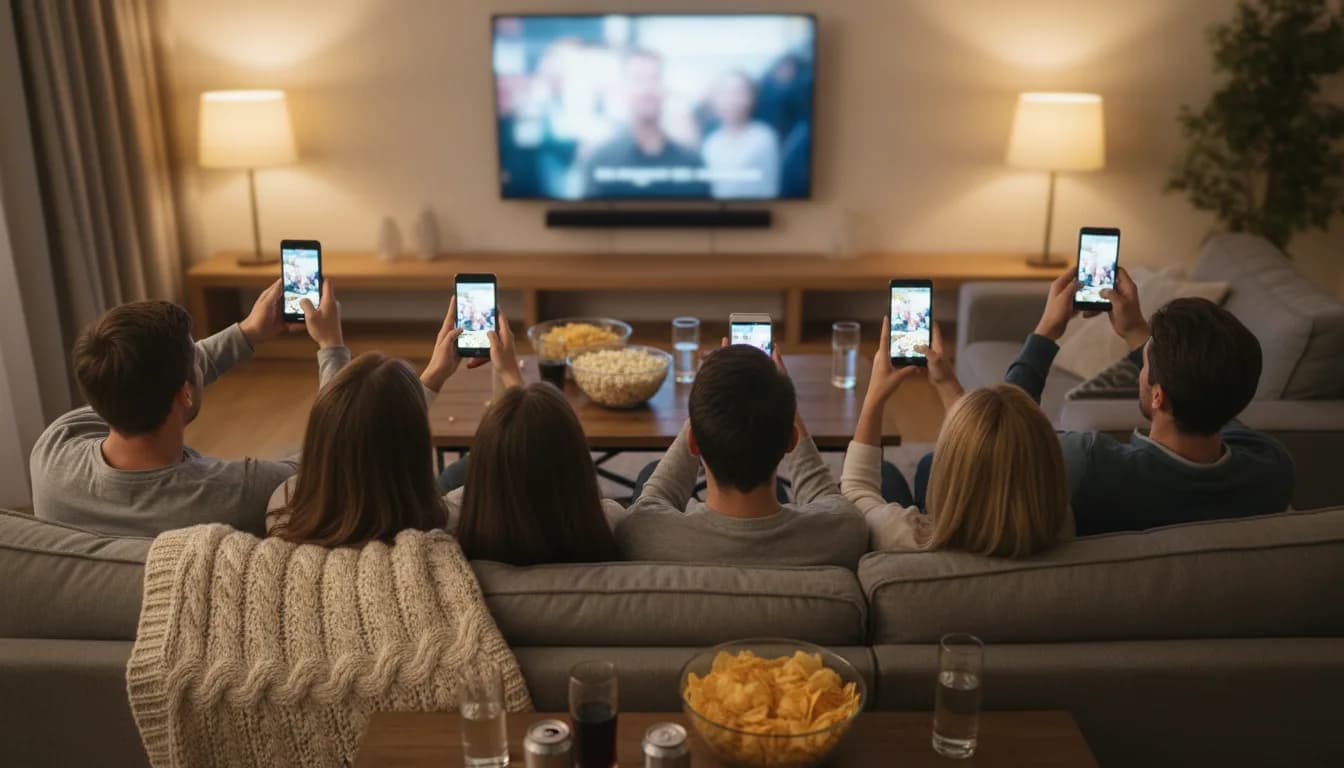
The shortcut is to stop pairing hardware altogether. Games where the phone is the controller sidestep the wall completely, because every guest walks in already carrying an input device that is charged, paired to nothing, and familiar.
The cheapest eighth controller
If you are one pad short at 8pm, no shop trip fixes it in time. A game where players join from their own phone turns a hardware problem into a QR code.
The downtime wall: turn-based games get worse with every chair
The second wall is arithmetic. In a game with individual turns, your waiting time is everyone else's turn time added together. At four players and one minute per turn you wait three minutes. At eight players you wait seven, over and over, all evening. Nothing about the game got worse, there are simply more people in front of you.
That is why so many well-loved games quietly stop being fun above six, and why the games that do survive a crowd almost always share one trait: people act at the same time rather than one after another. Simultaneous card selection, real-time team play, everyone writing an answer at once, everyone drawing at once. Look for that property first and the shortlist gets very short.
Above six players, stop asking what the game is about and start asking what everybody else is doing while it is not their turn.
Games where everyone plays at once, from the phones in the room
This is the format that solves the controller wall and the downtime wall at the same time: one screen everybody looks at, and a phone in every hand. Nothing to pair, and every player is doing something in every round.
Jackbox Party Pack: the reference point. Most games take up to 8 players, some packs go to 10, and an audience of up to 10,000 can vote alongside them. One person needs to own a pack and run it on a screen.
The Jackbox Party Essentials on Netflix: since 7 April 2026 a Netflix subscription gets you Drawful 2, Fibbage 4 and Quiplash 3 through cloud gaming, with phones as controllers and no console in the room.
AirConsole: turns a browser on a TV or laptop into a console and phones into gamepads, with a catalogue that includes party titles built for very large rooms. Free to try, with limits on the free tier.
Gartic Phone: the drawing telephone game, free, 2 to 30 players, no accounts. The single easiest way to absorb a crowd that keeps growing.
skribbl.io: draw and guess in private rooms, free, up to 20 players, and simple enough that nobody needs the rules explained twice.
Buzzin: a game show that runs in the TV browser for 2 to 8 players, with a voiced host doing the pacing so no guest has to referee.
Board games that hold up at six, eight and beyond
Cardboard still wins for a certain kind of evening, as long as you pick for player count rather than for the review score. These are the ones built to take a crowd, with the counts as published.
Herd Mentality: 4 to 20 players, 15 to 20 minutes. Everyone answers a question at the same time and tries to match the majority. Scales almost linearly and explains itself in one sentence.
Telestrations Party Pack: 4 to 12 players. Drawing and guessing passed around the table, everyone busy at once, no reading of rules.
Blood on the Clocktower: 5 to 20 players. Social deduction that is actually designed for big numbers, with a storyteller keeping it moving and eliminated players still in the conversation.
Captain Sonar: 2 to 8 players, best as two teams of four. Real time rather than turns, so nobody is waiting for anybody.
7 Wonders: 2 to 7 players. Card drafting where everyone chooses simultaneously, which is why it plays at seven in roughly the same time as at four.
Camel Up: 3 to 8 players, and up to 10 with the Supercup expansion. Betting on camels, short turns, and the fun is mostly in watching other people commit.
Codenames: two teams, so the group size stops mattering once you are past four. Only two people are talking at a time, and everyone else is arguing about what they meant.
Watch the difference between the box and the table
A box that says up to 12 players is telling you what fits, not what is fun. Games with simultaneous play or teams keep their pace at the top of their range. Games with individual turns rarely do.
The cheat sheet by headcount
If you know how many people are coming, this is the shortest path to a decision.
Five or six: almost everything still works. This is the only size where you can pick by taste rather than by constraints, and where a heavier board game is still a good idea.
Seven or eight: the controller wall arrives. Go for phones as controllers, teams, or a simultaneous board game. This is also the size at which a voiced host or a strict timer starts earning its keep.
Nine to twelve: split or scale. Either two tables running different games, or one game explicitly built for the number, such as Blood on the Clocktower, Herd Mentality or the Telestrations Party Pack.
Thirteen and up: only formats where people play in teams or in waves. Team quizzes, drawing games with big lobbies, or a winner-stays-on rotation on a single screen with everyone else watching and heckling.
What to sort out before people arrive, not during
Ninety percent of big-group evenings that go wrong go wrong in the first fifteen minutes, on logistics rather than on the game.
1Test the screen and the sound before anyone rings the doorbell. A game show with no audio is just a slideshow.
2Count seats that face the screen, not seats in the room. Anyone sitting behind the TV is out of the game before it starts.
3Decide the team split in advance if you are over eight. Doing it live turns into ten minutes of negotiation.
4Pick one game that needs no explanation for the first round. Save the rules-heavy pick for when everyone is warmed up.
5Have a fallback that needs nothing at all. If the wifi dies, a game everyone can play with zero equipment saves the night.
One TV and that is it
The setup that removes the controller problem: one screen for the room, one phone per person.
This is the format we build for. Buzzin runs a game show on whatever screen you already have, a smart TV browser, a Chromecast or a laptop on an HDMI cable. Players scan a QR code, so the phones become buzzers and nobody installs anything, creates an account or hunts for a spare gamepad. The flagship show, TV Show, is run by a voiced host who reads the questions, reacts to the answers and keeps the pacing, which is the job somebody in the room usually has to do by hand.
It plays with 2 to 8 people, which is exactly the range where the controller wall hits hardest. Content is written per language rather than translated, so a Polish, German or Spanish group gets questions that were written for them.
If you run these nights often and want to argue about what works, the Discord is open. We read everything people tell us about what played well and what they would change.
Frequently asked questions
What party game works for 10 or more people?
At ten and above, pick a game that was designed for the number instead of one that merely tolerates it. Blood on the Clocktower runs from 5 to 20 players, Herd Mentality from 4 to 20, the Telestrations Party Pack from 4 to 12, and Gartic Phone handles up to 30 in a browser for free. The other reliable route is teams: two teams of six behave like a six-player game with more shouting.
What are good Christmas party games for a large group?
The same rules apply, with one addition: at Christmas the group is usually mixed in age and in patience. Favour games that explain themselves in one sentence and where everyone plays every round, so a grandparent is never sitting through six turns. Drawing and answering games work well, team quizzes work well, and anything running on the TV with phones as controllers avoids the argument about who gets the second gamepad.
What can we play when half the group are not gamers?
Choose the input, not the genre. People who never game are not put off by trivia or drawing, they are put off by a gamepad with sixteen buttons. A game where the whole interface is tapping an answer on your own phone removes the barrier, and so does any board game where your entire turn is writing a word or picking a card.
Do all my guests have to install an app?
They should not have to, and it is worth checking before the night. Browser-based games ask for nothing more than a link or a QR code. If a game needs every guest to install something, expect to lose a chunk of the room at the door, especially the people who came for the company rather than for the game.
How many people can play Jackbox at once?
Most Jackbox games cap at 8 players, some packs allow 10, and on top of that an audience of up to 10,000 can join and vote without being a player. One person still needs to own the pack and run it on a screen everybody can see, or use The Jackbox Party Essentials on Netflix, which has been available since 7 April 2026.
How do you stop a big group from getting bored between turns?
Give everyone something to do in every round. That means simultaneous play, teams, or a game where the audience has a role. If you are committed to a turn-based game with a crowd, use a visible timer per turn and keep the rules explanation under three minutes, because the wait is what people remember, not the mechanics.
Written by
Eryk Kruk · Buzzin Founder
I build Buzzin and test every one of these games at my own game nights. Got a question about this piece, or an idea for the next one? Write me: contact@playbuzzin.com