Family Christmas Games 2026: What to Play When Three Generations Share One Living Room
The Christmas table is the hardest crowd of the year: three generations, no patience for rules and a TV that has been busy since lunch. Here is how to pick games for those constraints, from one-sentence games to the TV without a console, with an hour-by-hour plan.
Christmas Day, about half past four. Dinner is over, the table has not been cleared, and the room holds an eight-year-old, two teenagers, four adults and a grandmother who has not played a game since the last time you all sat here. Someone says we should play something. Someone else reaches for the remote.
Most lists of family Christmas games hand you thirty ideas and leave the hard part to you: which of them survive that room. This guide is built the other way round. It starts with what actually goes wrong at a Christmas table, then sorts the games by the constraint they solve, with player counts checked against the publishers rather than remembered. At the end there is an hour-by-hour plan for the evening and answers to the questions hosts ask every December.
Why the Christmas table is the hardest crowd of the year
A game night with friends is easy. Everyone is roughly the same age, everyone came for the game, and if something does not land you switch. Christmas gives you none of that. The people at the table did not come to play, they came for each other, and the game has to earn its place in the evening.
Five things work against you at once, and any game you pick has to get past all five.
The age spread. The youngest player might be six and the oldest eighty, and a game that suits one end usually bores the other.
No patience for rules. If the explanation takes longer than a sentence or two, half the room has already drifted to the kitchen.
Everyone is full and sitting down. Games that need people to stand up or fetch things start slowly, if at all.
The TV is taken. It has been showing a film or a match since lunch, and there is a good chance nobody in the house owns a console anyway.
Half the room does not play games. For them looking silly in front of family is a real risk, and the first round decides whether they stay.
The one rule that matters more than the game
At Christmas, the first game of the evening must be one nobody can lose badly. The person who feels stupid in round one does not come back for round two, and neither does anyone sitting next to them.
Games you can explain in one sentence
This is the filter that sorts most Christmas game lists into two piles. If you cannot explain the game in one sentence while people are still passing dessert, it belongs to a different evening. The games below pass that test and need nothing you do not already have in the house.
Christmas charades: mime a Christmas film, carol or object, no talking, your team guesses. Works from six to eighty, and the grandparents know more carols than the teenagers.
Name that carol: hum the first bars of a Christmas song, the first person to name it takes the next turn. Zero props, and it takes ten seconds to start.
Two truths and a Christmas lie: each person tells three Christmas memories, one made up, and the table votes on the fake one. This is the game that gets the quiet uncle talking.
The left-right gift game: someone reads a short story out loud, and every time it says 'left' or 'right' everyone passes the small wrapped gift they are holding in that direction. When the story ends, you keep what is in your hands.
Herd Mentality: everyone writes an answer to a question like 'name a Christmas food' and you score by matching the majority, not by being right. Officially 4 to 20 players, about 20 minutes, ages 10 and up.
Christmas Pictionary on napkins: one person draws, the table shouts. A pen and the napkins already on the table are the whole kit.
Games at the table, right after dinner
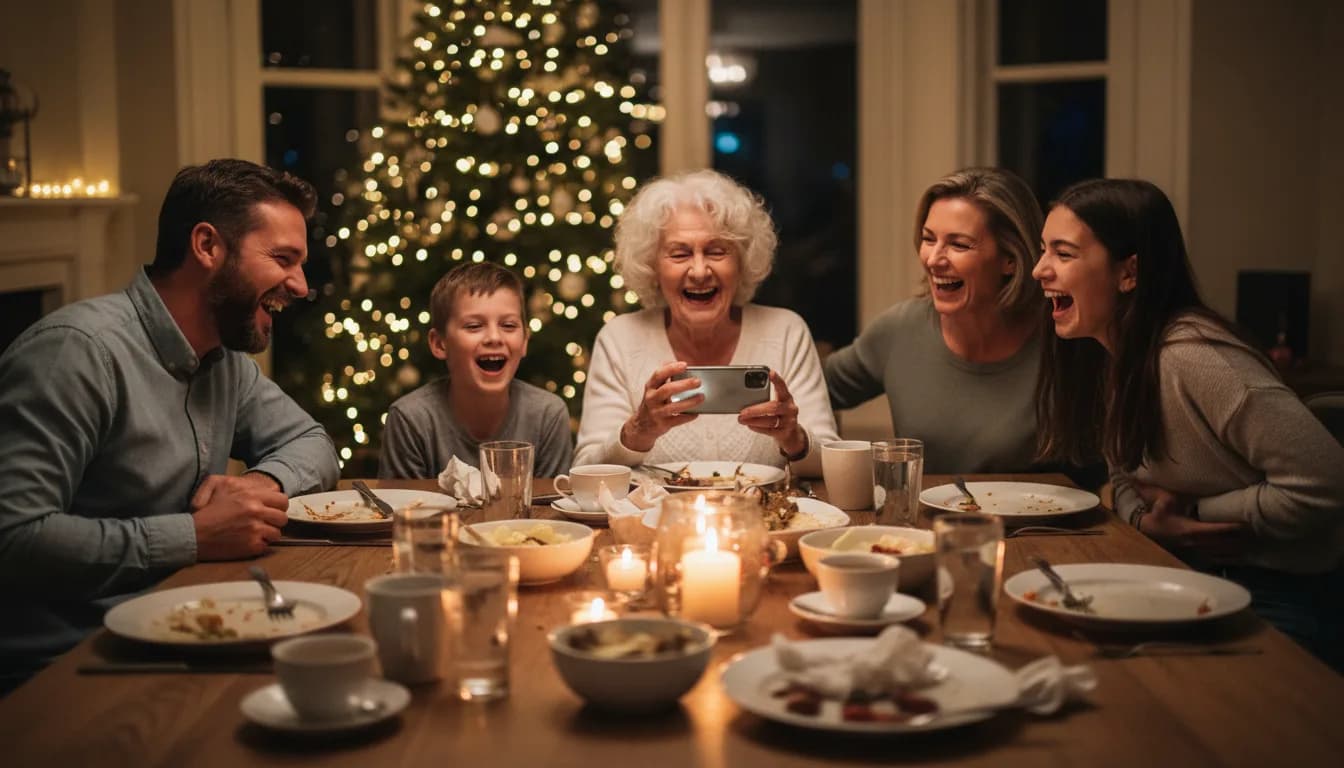
The half hour after dinner, when nobody wants to get up: one phone in the middle of the table is often enough.
The best window of the evening is the half hour after dessert, when everyone is still in their chairs and nobody has moved to the sofa yet. The games below are built for that moment: seated, short rounds, a table half covered in plates. Player counts are the publishers' own.
Just One: 3 to 7 players, about 20 minutes, ages 8 and up. Everyone writes a one-word clue for the guesser and identical clues get cancelled. It is cooperative, so nobody loses alone, which is what you want in round one.
Codenames: officially 4 to 8 or more, 15 minutes, ages 10 and up. Two teams, one-word clues, and the whole table argues about what the clue-giver meant. Only two people talk at a time, so it scales to any table.
Wavelength: 2 to 12 players in two teams. One player gets a secret spot on a scale like 'bad Christmas present' to 'great Christmas present' and gives a clue, the team dials in a guess. The arguments are the point.
Telestrations 12 Player Party Pack: 4 to 12 players. Draw, pass, guess, pass, and see what the phrase turned into by the time it comes back. Everyone draws at once, so nobody waits.
Poetry for Neanderthals: 2 or more players, about 15 minutes, ages 7 and up. You may only use one-syllable words, and a teammate bonks you with an inflatable club when you slip. Kids adore policing the grown-ups.
Box counts and table counts are two different numbers
A box that says 8 players tells you what fits, not what is fun. Games where everyone acts at once, or where two teams talk in turn, keep their pace at the top of their range. Games with one player acting at a time rarely do.
Games on the TV when there is no console
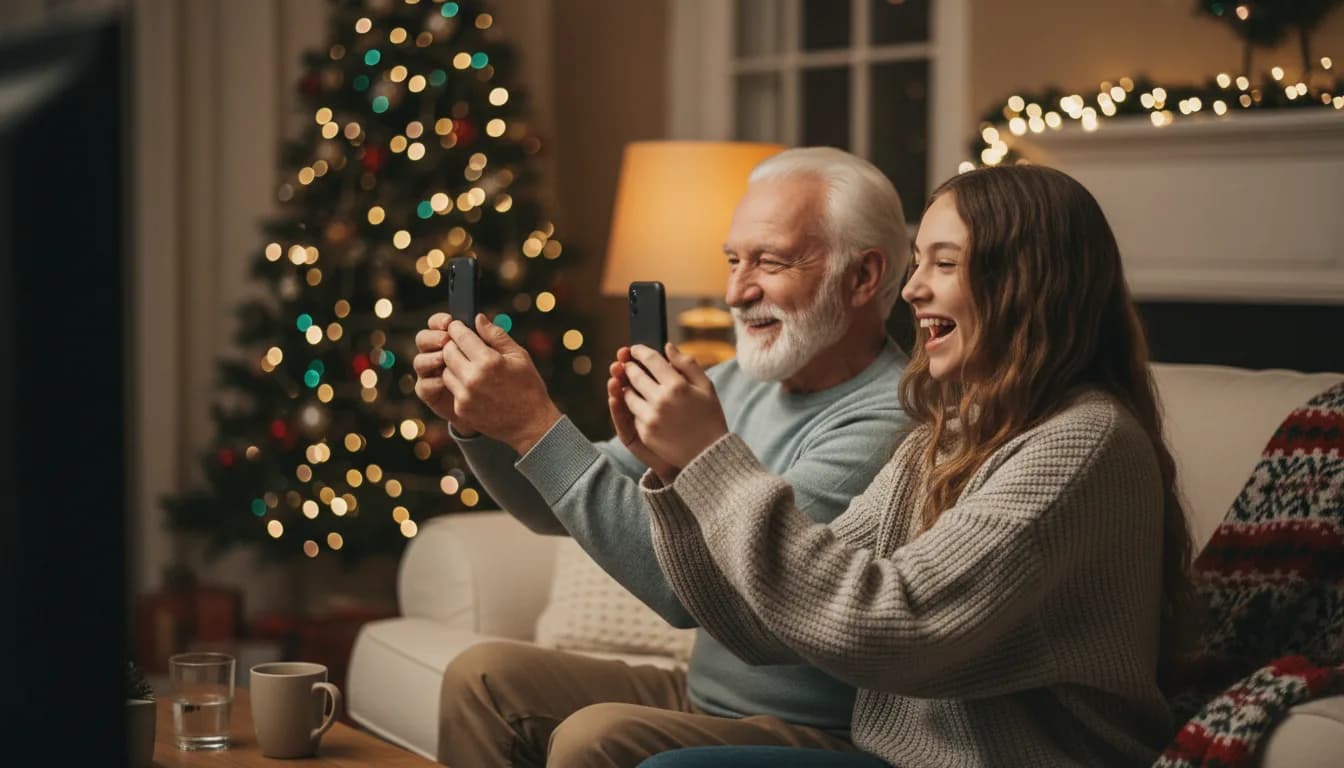
The same TV that showed the film all afternoon, once the room agrees to switch the input.
At some point the film ends and the TV becomes the best thing in the room: the one screen everyone is already facing. Two facts decide what you can do with it. Most family homes have no console in the living room, and every guest walked in with a phone. The games below run on the TV itself or on a laptop plugged into it, and the phones do the rest.
The Jackbox Party Essentials on Netflix: since April 2026 a Netflix subscription includes Drawful 2, Quiplash 3 and Fibbage 4 in the games row of the TV app, up to 8 players, with phones as controllers through a QR code and Netflix's Game Controller app. It works on many recent TVs and streaming devices in a limited list of countries, so check that you can see the games row before the guests arrive.
The Jackbox Party Packs: the reference for this format. Most games take up to 8 players, some packs 10, and everyone joins from a phone browser with a room code. The games are rated T for Teen, so switch on the Family Friendly setting in the lobby, which filters out suggestive prompts. It locks once the game starts, so do it before anyone joins.
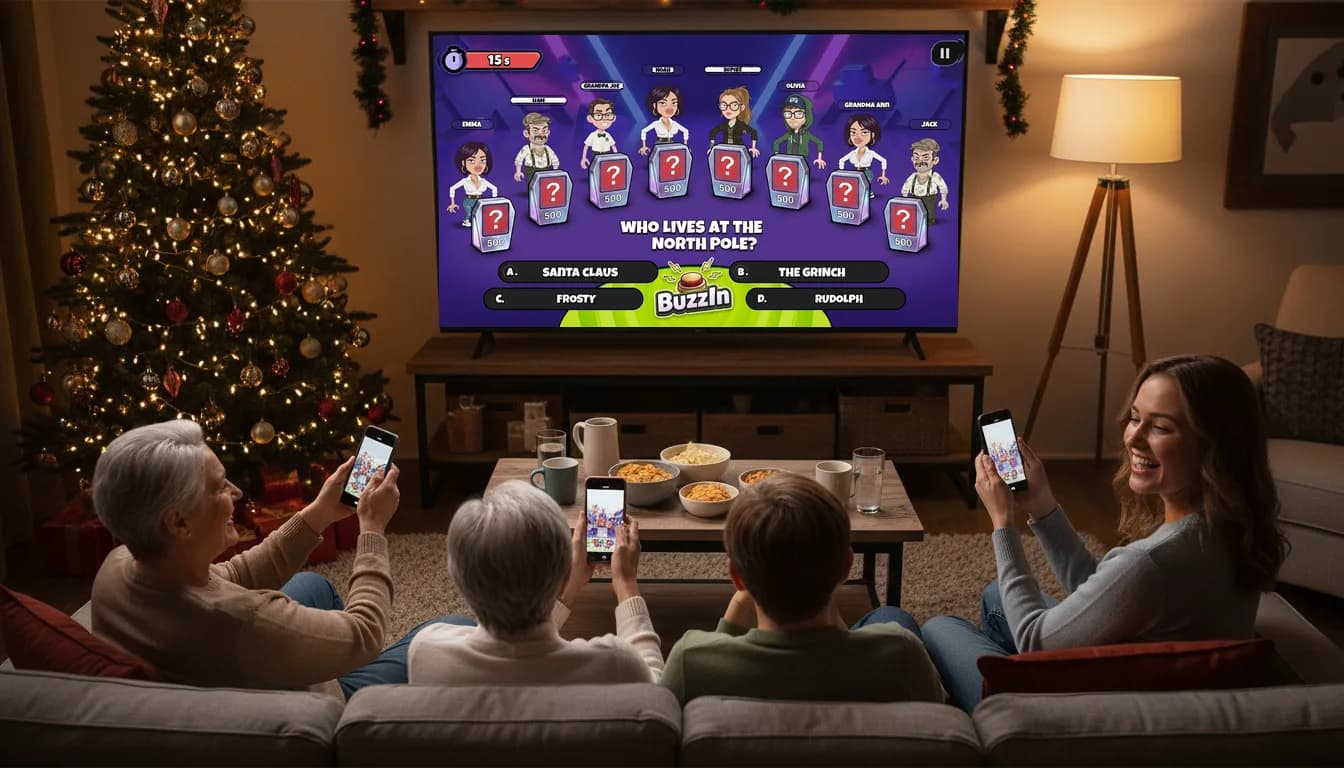
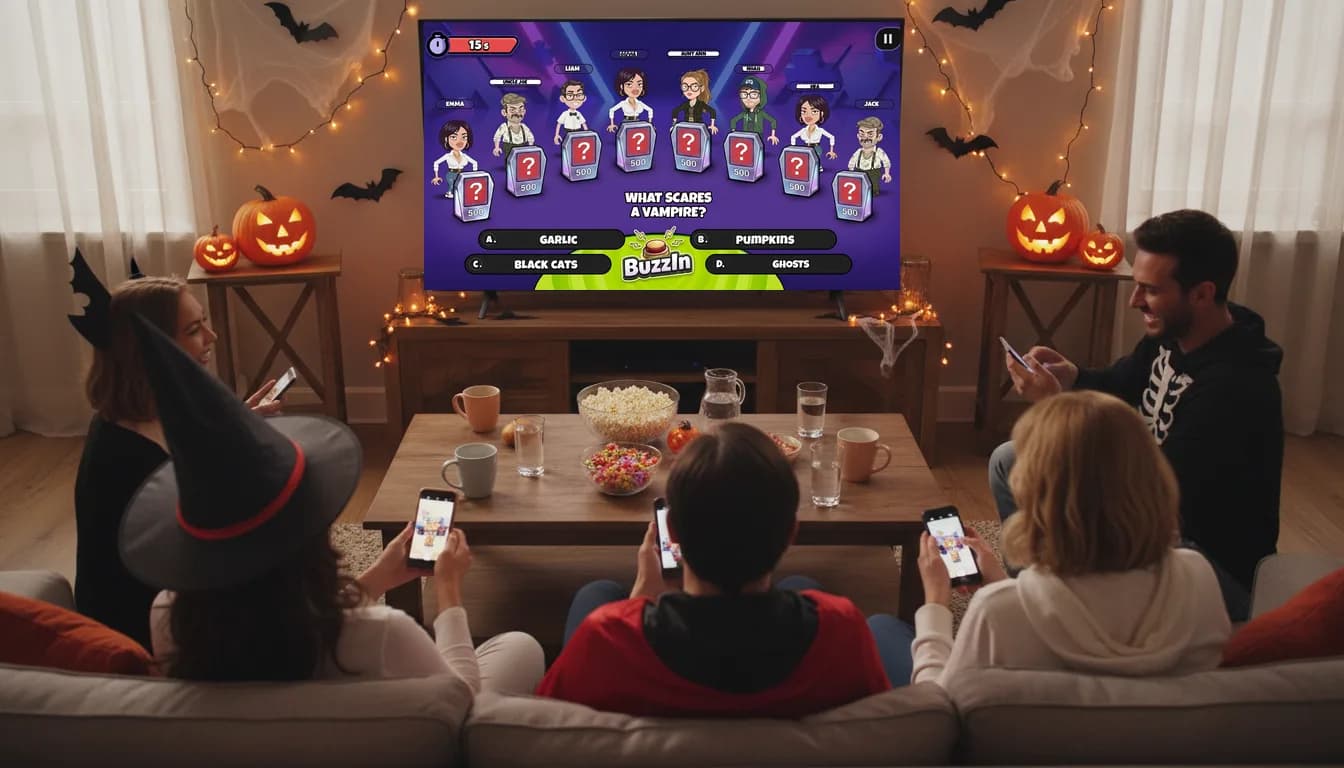
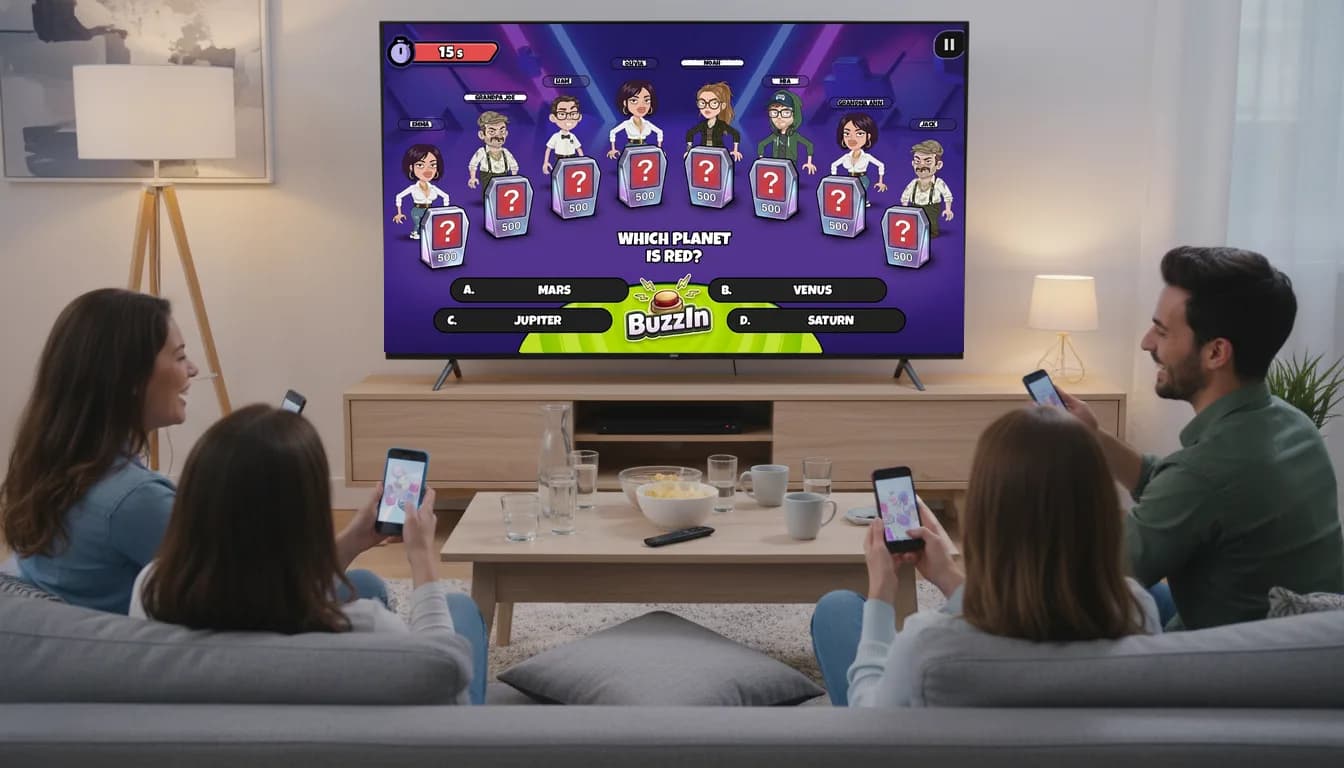
Buzzin: a game show that runs in the TV browser or on a Chromecast, 2 to 8 players, with a voiced host who reads the questions and keeps the pace. Players scan a QR code and their phones become the buzzers, with nothing to install, which matters when the oldest player has never downloaded an app.
Gartic Phone: the drawing telephone game, free, 2 to 30 players, in a browser. Open it on a laptop on the HDMI cable and everyone draws on their phones.
The console you were missing has been in everyone's pocket the whole time.
Christmas trivia that does not leave grandma last
Christmas trivia is the most searched Christmas game there is, and the most commonly ruined. The usual failure is a quizmaster reading forty questions written for one generation: the teenagers win the film round, the grandparents win the carol round, and everyone in between is bored. Three fixes turn it into the best half hour of the night.
Mix eras inside every round, not between rounds. One question about a 1940s song, one about a 2003 film, one about a Christmas food. Nobody gets a round they cannot touch.
Play in teams of one adult, one child and one grandparent. Mixed teams answer more questions than any single generation could, and nobody sits out.
Let the TV or a phone ask the questions. A voiced host or a timer removes the quizmaster, so the person who usually reads the questions gets to play for once.
Eight Christmas trivia questions to start with
Answers in brackets, and the spread across generations is deliberate.
How many gifts are given in total in 'The Twelve Days of Christmas' if you count every gift in every verse? (364)
Rudolph the Red-Nosed Reindeer was created in 1939 as a promotion for which American store? (Montgomery Ward)
In 'Home Alone', where does the McCallister family fly to while Kevin is left behind? (Paris)
What is the name of the Grinch's dog? (Max)
How many reindeer pull Santa's sleigh in the 1823 poem 'A Visit from St. Nicholas', long before Rudolph was invented? (Eight)
Saint Nicholas, the bishop behind Santa Claus, was born in Patara, a town in which modern country? (Turkey)
Which country is usually credited with starting the tradition of the decorated Christmas tree, back in the 16th century? (Germany)
Whose 1931 advertising paintings by Haddon Sundblom fixed the image of Santa in a red suit for most of the world? (Coca-Cola)
Games with zero equipment, for when the room is full
Every Christmas plan needs a fallback for the moment the wifi drops or twelve people squeeze into a room built for six. These need nothing but the people, and everyone stays exactly where they are.
I went to the North Pole and packed: the memory chain. Each person repeats the whole list and adds one item. Kids beat adults at this surprisingly often.
Twenty questions, Christmas edition: one person thinks of a Christmas thing, the room gets twenty yes-or-no questions to find it.
Who am I: everyone gets a Christmas character whispered to them and asks yes-or-no questions to work out who they are. Even the six-year-old can be Rudolph.
Fortunately, unfortunately: build a Christmas story one sentence at a time, alternating a good turn and a bad one. Nobody wins, which is exactly why the non-players join in.
Carol karaoke without the machine: someone starts a carol, the next person has to continue from where they stopped. Wrong words are the fun part.
The evening, hour by hour
Games at Christmas are not one block but three or four short windows between the things the day is actually about. Plan for the windows and you never have to talk anyone into playing.
1Late afternoon, guests arriving: nothing organised. Hand the kids a memory chain or Who am I while the adults talk, and leave it there.
2Straight after dinner, everyone still seated: one game you can explain in a sentence, such as Herd Mentality or Just One. Fifteen to twenty minutes, then stop while it is still fun.
3Early evening, the film is over: the TV window. A game show on the screen with phones as buzzers, because everyone is already facing the TV and nobody has to move. Forty minutes is plenty.
4Kids to bed, adults still around: Codenames, Wavelength or a proper trivia round. This is where the longer games belong, not at half past four.
5Late, six people left: back to zero equipment. Carol karaoke or Fortunately, unfortunately, until somebody falls asleep on the sofa.
Stop before people ask to stop
The single most useful habit for a Christmas host: end each game while the room still wants another round. It is what makes the next window easy to open.
Start it on the TV, the rest is in your pocket
This is the format we build Buzzin for, and Christmas is where it earns its keep. The show runs on whatever screen is already in the room: a smart TV browser, a Chromecast or a laptop on an HDMI cable. Players scan a QR code and their phones become the buzzers. No app, no account, no spare controller to find, which is the difference between a game that starts in a minute and one that never starts.
The flagship show, TV Show, has a voiced host who reads the questions, reacts to the answers and keeps the pace, so nobody at the table has to be the quizmaster. It plays with 2 to 8 people, and content is written per language rather than translated, so a family in Berlin or Warsaw gets questions written for them.
If you run these evenings and have opinions about what worked, the Discord is open. We read everything people tell us about what played well and what they would change.
Frequently asked questions
What are good Christmas games for a large group of 10 or more?
Pick games where everyone acts at once, or play in teams. Herd Mentality is published for 4 to 20 players, the Telestrations Party Pack for 4 to 12, Wavelength for 2 to 12 in two teams, and Gartic Phone takes up to 30 in a browser. On the TV, Jackbox caps at 8 or 10 depending on the pack and Buzzin at 8, so above that play in pairs behind one phone. Charades and team trivia have no ceiling at all.
What Christmas games work for kids and adults at the same time?
Games where knowledge does not decide the winner. Charades, Telestrations, Just One and Poetry for Neanderthals all let a seven-year-old beat an adult. For trivia, put one child, one adult and one grandparent on each team. For anything on the TV, check the content setting before anyone joins: Jackbox games are rated T for Teen and have a Family Friendly filter that locks once the lobby fills.
What if someone does not want to play?
Give them a job instead of a seat: reading the story in the left-right game, running the timer, judging the drawings in Telestrations. Half of the people who refuse the first round join the second once they have watched one. The other half are happy where they are, and a good host leaves them there.
What Christmas games can we play on the TV without a console?
More than most people expect. A Netflix subscription includes The Jackbox Party Essentials in the TV app with phones as controllers, Buzzin runs in the TV browser or through a Chromecast, and any browser game such as Gartic Phone works from a laptop on an HDMI cable. In every case the phones are the controllers, so the only thing to test in advance is that the TV can reach the internet.
What are easy Christmas games with no supplies at all?
Charades, Name that carol, Two truths and a Christmas lie, Twenty questions, the memory chain and Who am I. None of them needs more than the people in the room, and all of them can start while someone is still clearing plates.
Should we include drinking games at Christmas?
Not with three generations at the table. Every game in this guide works with a cup of tea in hand, and that is deliberate: the point of the evening is that the eight-year-old and the grandmother play the same round.
How long should a Christmas game last?
Shorter than you think. Fifteen to twenty minutes straight after dinner, about forty for a TV session, and always stop while people want another round. At Christmas the game is a bridge between the parts of the day people came for, not the main event.
Written by
Eryk Kruk · Buzzin Founder
I build Buzzin and test every one of these games at my own game nights. Got a question about this piece, or an idea for the next one? Write me: eryk@ravenlab.tech